

By Graley Herren

When the table of contents for The Philosophy of Modern Song was released some weeks ahead of publication, it was immediately clear that we were in for a strange trip. Dylan assembles a wildly eclectic, idiosyncratic collection of songs across various eras and genres. I was eager to see what he did with these individual pieces, but also to see how he connected separate fragments into a larger mosaic. To be honest, I hadn’t even heard of some of the songs on the list, including the bizarre sounding “Whiffenpoof Song.”
Once the table of contents leaked, it was quickly and inevitably followed by a Spotify playlist. I listened to “Whiffenpoof Song” and had that reaction familiar to all Dylan fans when he makes an unexpected and inscrutable swerve: What is this shit? I know Dylan loves Crosby, and the crooner’s honey-dripping voice does make the song somewhat palatable. But having swallowed “Whiffenpoof Song” once, I had no desire for a second dose. What could possibly inspire Dylan to write about this old-fashioned, lame-ass song?
Then the book came out and I thought I had my answer: He’s just taking the piss. Even before reading a word of the brief three-paragraph entry, the accompanying photograph establishes a sense of the ludicrous.
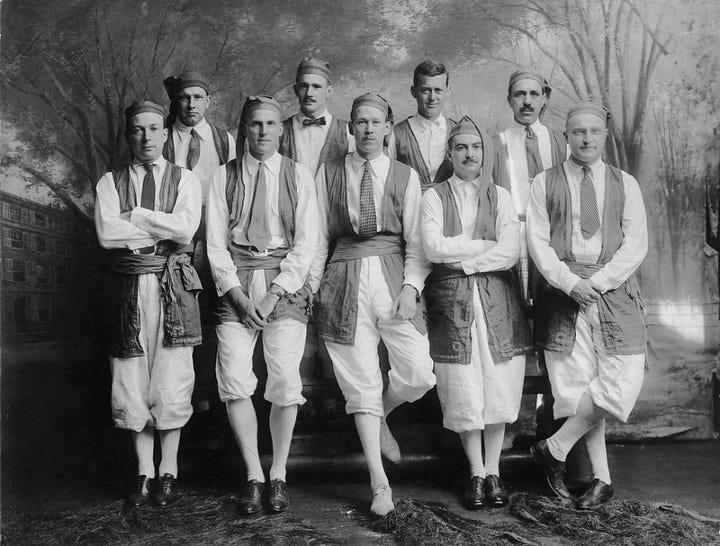
It looks like the group portrait of some goofy fraternity from the early 20th century, an artifact from a bad Turkish-themed masquerade party, the sort of thing that gets trotted out for a laugh at reunions, retirement parties, and funeral slide shows.
As counterpoint to the trivial photo, Dylan provides some outrageously overblown commentary on the song as if it were a powerful incantation conjured by black magic. “It’s predetermined, ordained, and comes right out of the book of Fate. Terrifying and hopeless. Guaranteed to keep your spirits up. It’s standoffish and inaccessible—a Cabalist song with a coded message. Sing it and it becomes entirely yours” (70). What?!? Nothing in this entry remotely resembles the inane and soporific effect the song has for me as a listener. I could only conclude that Dylan’s hyperbole was intended as satire, a farcical send-up of bad music criticism (a subject Dylan knows a thing or two about) which exaggerates, distorts, and entirely misses the point of a simple, pleasant, harmless little ditty.
That was my first impression. But now I’m on my second trip through The Philosophy of Modern Song, and I’m starting to notice things I missed the first time. Important, complex books like this reward multiple readings. You need to know the contours of the big picture before you’re in a position to appreciate how the smaller components fit together. I now recognize a more serious agenda at work behind the scenes and between the lines of “Whiffenpoof Song.”
Founded in 1909, The Yale Whiffenpoofs is an independent a cappella group at Yale University. The photo Dylan uses to head his entry is a group portrait of the 1910 class of Whiffenpoofs. One of the early members of the Whiffenpoofs was Prescott Bush. He went on to serve as a Republican U.S. Senator for the state of Connecticut from 1952 to 1963. But he is best known today as the father of George H. W. Bush (41st President of the United States) and the grandfather of George W. Bush (43rd President of the United States). When I was initially reading Chapter 15 on “Whiffenpoof Song,” I had no idea that I would eventually get to “War” by Edwin Starr (Chapter 43), where Dylan essentially accuses the 43rd President and his administration of war crimes.
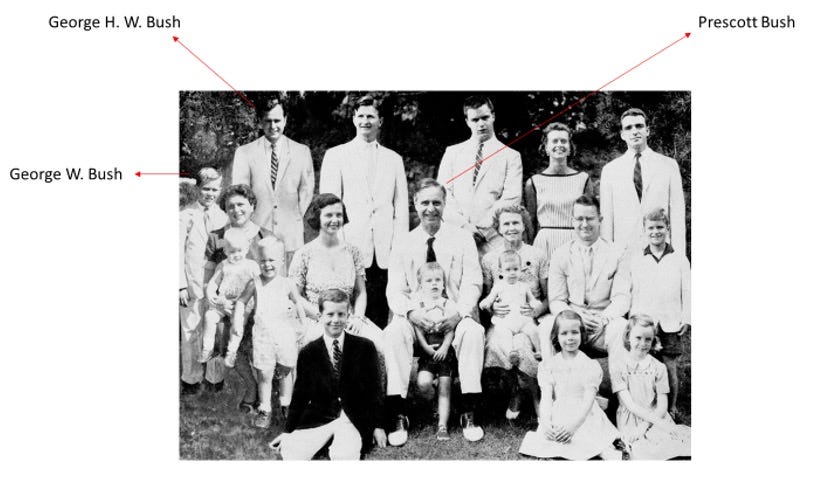
However, the Whiffenpoofs isn’t the most famous Yale organization to which Bush I (class of 1917), Bush II (class of 1948), and Bush III (class of 1968) each belonged. They were all members of the notorious secret society Skull and Bones. Membership in Skull and Bones is by invitation only to highly select Yale seniors. Members are sworn to lifelong secrecy about the group, so little is known about its inner workings. But one thing is abundantly clear: alumni from Skull and Bones have gone on to exert major power in the United States and across the globe, including three Presidents—Bush the Greater and Bush the Lesser, and before that William Howard Taft, whose father Alphonso Taft was a co-founder of the group in 1832—as well as industry tycoons, media magnates, top-ranking officials in U.S. national intelligence, and even a few prominent artists (including Archibald MacLeish). Skull and Bones is a favorite target for conspiracy theorists, too, who compare the privileged and powerful secret society to the Freemasons and the Illuminati.
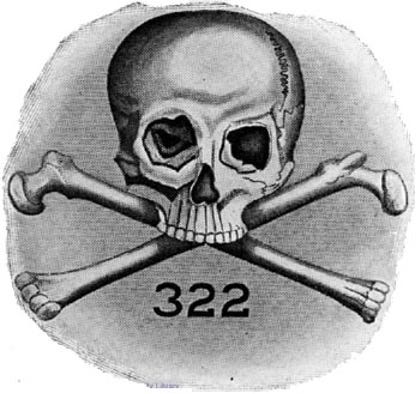
With this information in mind, go back to Dylan’s commentary in Chapter 15 and it becomes clear that he is not really writing about the Whiffenpoofs, he is writing about Skull and Bones. “This song is the grinning skull. An in-crowd song, a song with a pedigree, a song in the Social Register. Not meant for the middle class to understand—seems to house a deep dark secret. […] A lot of bones and skeletons in this song. […]. This is a song sung by dues-paying members of the inner circle” (69). Oh, you’re a sly one, Bob! Dylan claims the song is written as a coded message; meanwhile, he writes a commentary that is itself a coded message about this secret society with mysterious powers.
Here is another context for appreciating Dylan’s use of the song within the larger context of the book. One of the most notorious allegations against Skull and Bones is that members (called “Bonesmen”) raided the tomb of the great Apache leader Geronimo in Fort Sill, Oklahoma, in 1918, stealing his skull and some bones and a few possessions buried with him, and whisking them away to The Tomb: the members-only headquarters of Skull and Bones in New Haven, Connecticut. This crime has never been definitively proven or disproven. Nevertheless, Harlyn Geronimo was so convinced of its validity that he filed a lawsuit in 2009, on the 100th anniversary of his great-grandfather’s death, against Skull and Bones, Yale University, and the U.S. Government, demanding the return of Geronimo’s remains. To my knowledge, nothing has ever been returned and the case remains unresolved. Viewed in light of this information, the chapter on “Whiffenpoof Song” now makes for an interesting intertextual dialogue with one of the most powerful chapters in the book, Chapter 40, on John Trudell’s “Doesn’t Hurt Anymore.”
Trudell was a Santee Dakota civil rights activist and spoken-word poet. As Dylan recounts in Chapter 40, his outspoken advocacy and protests for Native American justice led to the violent murder of his family: “Sometime in the late seventies, John led a demonstration of various tribal people in Washington on the steps of the Capitol. A day after that, his trailer in Nevada on the Duck Valley Reservation was firebombed and a padlock was put on the outside of the door. John’s pregnant wife and three kids and mother-in-law were burned alive. The arsonists were never apprehended. This gives you an idea of what’s deep down in the heart and soul of the songs that John would write” (198).

Dylan’s commentary on “Whiffenpoof Song” is a riddle, an exercise in concealment and sleight of hand. His commentary on “Doesn’t Hurt Anymore” is motived by opposite impulses to expose, to speak out, to recover, to draw attention, to pay respect, and to pledge solidarity. “Take a moment—read a little more about John Trudell than what is offered here. He deserves it. And after you do, seek out his music. A good place to start would be the AKA Grafitti Man album, full of simple direct performances with John accompanied by his Oklahoma soul brother Jesse Ed Davis” (199). If you take this advice and listen to the album, you will hear a song called “Bombs Over Baghdad,” Trudell’s lyrical protest against the first Gulf War presided over by George H. W. Bush.
Let me add one more link in the chain that binds together these disparate stories, songs, and commentaries. The person long rumored as ringleader of the Oklahoma raiding party on Geronimo’s grave in 1918 was a Bonesman stationed at Fort Sill, Oklahoma. He had graduated from Yale the previous year and was in training to serve as an artillery officer in World War I. He had a bright future ahead of him, and apparently a pretty good singing voice, too. You have probably solved the riddle by now. The man who allegedly staged this elaborate prank to impress his classmates by desecrating the burial grounds of Geronimo was none other Prescott Bush, the illustrious Bonesman, Whiffenpoof, Senator, and Sire to Presidents.

What a distance Dylan travels between these chapters, from Oklahoma to Yale, from The Tomb of Skull and Bones to the skull and bones stolen from the tomb of Geronimo, from the privilege and power of the Bush family to the disenfranchisement and death of the Trudell family, from the quintessential American insiders protected behind the ivy walls of a members-only society to the quintessential American outsider on the wrong side of the wall—an outlaw and exile in his native land.
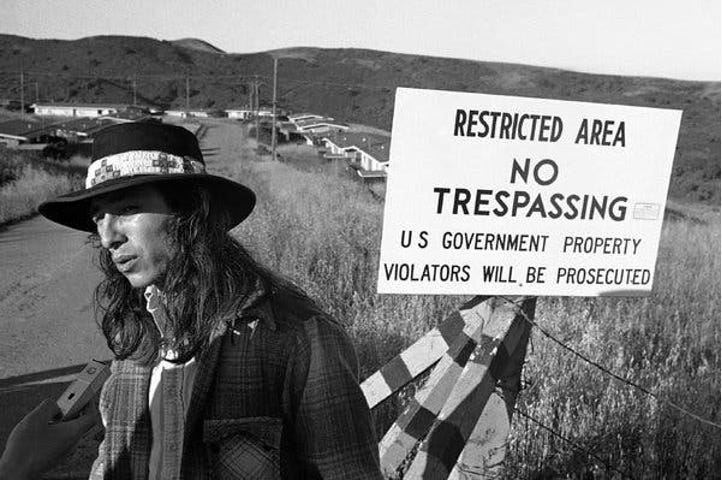
The picture at the beginning of Chapter 40 features John Trudell standing in front of a private property sign that reads: “Restricted Area / No Trespassing / US Government Property / Violators Will Be Prosecuted” (194). The singer in Woody Guthrie’s “This Land Is Your Land” encounters a similar prohibition, only to inform us: “But on the other side / It didn’t say nothing / That side was made for you in me.” Bob Dylan reminds us which side he is on in The Philosophy of Modern Song. He reasserts his enduring allegiance with the outsiders in their ongoing struggle against the insiders. He is on the side of the outcasts, the poor huddled masses yearning to be free. He is opposed to the Bonesmen and the Whiffenpoofs, the Masters of War.

This is fascinating, Graley! The connections you’ve made are insightful, naturally, and provide a thread of your response to Nina’s question about why this is a major work. Thank you for sharing your thoughts so completely and eloquently.
This is remarkable historiography, Graley, and are you not willing to give yourself much of the credit for excavating the materials and constructing the story of Bushes-bones-plutocratic privilege-imperialism-John Trudell and depredation of people and histories. That is a powerful and viable narrative you make, and it helps me think about the philosophy of modern song as exactly the work you do here: that everything about modern American popular song creates the kind of network you illuminate of American culture, American commerce and industry, American ideology, representative or revolutionary individual narratives, the moral and physical violence that America can’t get enough of/away from. Dylan invited you to find this historical network in the songs you discuss, and modern American popular song is uniquely able to generate these networks, and that’s the philosophy? I’m also thinking about your ability to elevate Dylan’s perfectly righteous and informed but also commonplace political critique on “War,” and the fact that reservation road signs like the one in the Trudell photo are not infrequently used as a counterpoint illustration to This Land. By bringing these elements into your narrative, you make them more than the sum of their parts, and I’d say again, give yourself credit for this. (The entry on Don’t Let Me Be Misunderstood seemed to point to a shaky and meager version of what you did: He doesn’t read Nina Simone’s version as I always have and other people do, as a particularly existential civil rights anthem, demanding not just visibility and voice, but to be known. The white British Animals did the white British 60s Black music appropriation thing, and enjoyed profit and fame from a pop version of the song miles from Simone’s intimate and challenging reading. Elvis Costello’s record company ignored his wishes and released his version of the song as a single in 1986—his anger at this incident is specifically targeted at the record company’s refusal to see him as something more than a marketable pop-punk crossover. And capping this off is Dylan’s rant against the prison of understanding/misunderstanding that art and artists have to suffer. “Idiot Wind” runs through this cycle of misunderstandings: the song itself, its iterations, and then Dylan’s reading of it. Is this Dylan’s cleverness or my mediocre cleverness?)
Dan Chiasson’s review of the book in NYRB mentions something crucial that needs to be said out loud, and that your celebration of what could be one of Dylan’s aims with the book also speaks to: Chiasson writes that the songs here are “the musical reef that he dynamited, utterly obliterated, using only his voice, his attitude, and his harmonica.” Can we say that the book has a deeply tragic element of genius to it—that the aged Bob Dylan has managed to remove himself from the history he literally ended, single-handedly. He is done, and his book asks us to do all this storytelling work, perhaps putting him in the story too, while he scurries off stage as he always has? Now I’m sad. But I wouldn’t have got here without your essay.